With over 200 semiconductor-related companies in the greater Phoenix metro area, some consider it the capital of United States chip manufacturing. According to Roccasecca, Gaikwad, and Khanbabei, Phoenix was able to get to this point through business-friendly tax structure, inexpensive land, key geographic location, and history in the industry.[i] In this post, we will explore some of the pieces that have put Phoenix on the map for semiconductor research and fabrication.
Key Stats:
As of 2025, over 200 semiconductor-related companies call Phoenix home[i]
Each chip manufacturer requires 10,000+ suppliers across the globe[ii]
Over 176,000 people work in semiconductor-related fields in the Phoenix area. That number is expected to grow by 20,000 in the next few years[iii].
Nearly 2,000 graduates in semiconductor-related fields from Arizona universities enter the workforce annually.[iv]
38,000 students throughout Arizona are enrolled in engineering programs with 70% in semiconductor-related disciplines.[v]
$287.5 million public and private investment across two Arizona State University Programs- Materials-to-Fab Center and MacroTechnology Works.[vi]
Over $1 billion invested in upgrading I-10.[vii]
Over $300 million invested in city infrastructure across multiple municipalities.[viii]
Over 200 semiconductor companies in Phoenix
What began when Motorola opened a facility in 1949 has blossomed into Phoenix becoming the epicenter of the United States semiconductor foundry growth. According to the Reshoring Semiconductor Manufacturing in Arizona article in the Journal of Science Policy & Governance—as of 2025 there are 115 chip-related companies in Arizona.
Following Motorola’s presence in Phoenix, Intel built their first Arizona fab in Chandler in 1980. Laying the groundwork for others to follow and eventually enticing the world’s largest chip manufacturer, Taiwan Semiconductor Manufacturing Company, or, TSMC, to establish roots in the desert. So how did we get here and what does the future look like?

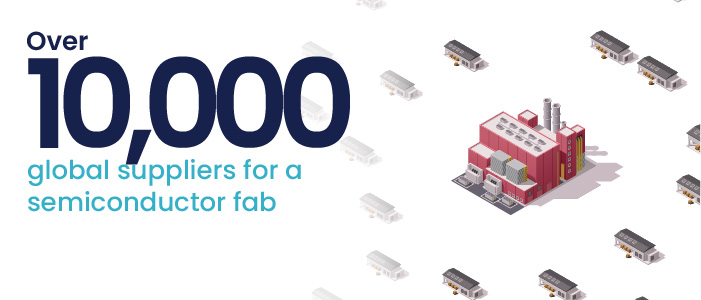
Each semiconductor manufacturer requires over 10,000 global suppliers
The semiconductor infrastructure is massive. Supporting a chip manufacturer requires an extensive ecosystem of highly specialized suppliers. In the Center for Strategic & International Studies piece “Mapping the Semiconductor Supply Chain: The Critical Role of the Indo-Pacific Region,” authors Thadini and Allen stated that top chip sellers have tens of thousands of suppliers across the globe.
This network drives for auxiliary businesses to establish a presence in the Valley to facilitate and support the intricate supply chain. This includes businesses like equipment manufacturing and repair, logistics companies providing material warehousing and transportation, and even construction firms that build infrastructure to meet rising demand. As mentioned earlier, the presence of semiconductor companies decades ago afforded Phoenix the time to establish itself as fab-friendly location.
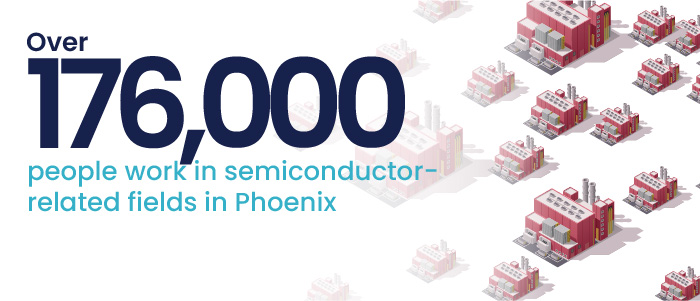
Over 176,000 people work in semiconductor-related fields in Phoenix
Not only does Phoenix currently have the supplier infrastructure to support growth, but it also has the workforce to handle the expanding industry. Per the Greater Phoenix Economic Council, as of 2024, there are 176,000 workers in fields related to chip making. That number is only increasing. This is important as the work needed to produce a chip is highly specialized. Manufacturers opening in areas without the necessary workforce face a major hurdle in standing up operations.

Nearly 2,000 graduates in semiconductor-related fields from Arizona universities enter the workforce annually
The good news about this growth is that the state’s universities are churning out the necessary trained talent. 1,800 graduates across the state are getting degrees in semiconductor-related fields each year. Flagship schools like Arizona State University and the University of Arizona have direct industry placement programs to feed the manufacturers in state. Strong partnerships have been developed and are continuing to grow between the education institutions and major players in the local semiconductor ecosystem.
38,000 engineering students across the state
The state of Arizona is not only showing strong numbers in new entrants to the workforce but also exhibits an astounding pipeline for the future semiconductor workforce. Again, according to the Greater Phoenix Economic Council, the state currently has 38,000 engineering students.
Workforce Programs
Many entities are working hard to fill the labor needs in the expanding chip-making sector.
Schools like Maricopa Community College offer fast-tracked semiconductor programs for workers pivoting into high tech manufacturing.[i] Accelerator and Apprenticeship Programs have been adopted by area high schools and community colleges.
New semiconductor programs are now offered at Northern Arizona University, Arizona State University, University of Arizona, Pima CC, and Central Arizona CC.[ii]

$287.5 million public and private investment across two Arizona State University Programs- Materials-to-Fab Center and MacroTechnology Works
Two of the highlighted public-private partnerships related to semiconductor manufacturing are based out of Arizona State University. The combined investment for both programs, the Materials-to-Fab Center and the MacroTechnology Works, is over $287.5 million.
Materials-to-Fab Center
The Materials-to-Fab Center is a world-class research, development, and prototyping facility. The purpose of the facility is to “accelerate the transfer of innovations from ideation to fab prototype.”[i] The lab is stocked with Applied Materials semiconductor manufacturing equipment. The goal of the center is to bring chip innovation to the forefront.
MacroTechnology Works
MacroTechnology Works serves as a working lab for the semiconductor. Private sector businesses, from start-ups to large multinationals, utilize the facility to build, test, and collaborate with university experts.[i] This facility also opens opportunities to ASU students to gain hands-on experience.
U of A and NAU
Other major investments have been made to expand University of Arizona’s Micro/Nano Fabrication Center and for Northern Arizona University to expand research and education programs.
Over $1 billion invested in upgrading I-10
Major investments have been made in education, training, and innovation, but major money has flowed into the physical infrastructure across Arizona and the greater Phoenix area. As mentioned earlier, major chip manufacturers have over 10,000 suppliers across the globe. This means that materials from all over the world must make their way to the fabs. Equipment, physical materials, chemicals, and gases are just a few of the items traveling along Arizona’s roadways. And most of these goods are entering the United States through major ports.
To support the ever-increasing flow of raw materials to Phoenix, the National Institute of Standards and Technology states that over $1 billion in funding has been earmarked to widen Interstate 10. I-10 directly connects Phoenix to major ports in Houston and Los Angeles making the area strategically important.

Over $300 million invested in city infrastructure across multiple municipalities
Cities like Phoenix, Chandler, and Peoria are all completing major infrastructure projects spurred on by the CHIPS Act. These investments total over $300 million and include roadway, water, and wastewater projects. Some of the projects address water reclamation and drought prevention.
This is another example of how many levers are being pulled to make semiconductor manufacturing successful in the Phoenix metro area.

Conclusion
Major steps are being taken throughout the greater Phoenix area to continue to support and grow a burgeoning semiconductor industry. From infrastructure to training, chip makers have a bright future in Arizona. Soon those 200 semiconductor-related businesses will surpass 300. Do you think Phoenix is the capital of the U.S. semiconductor market? If not, what city do you think might have a better claim?
Sources and Methods
The data was compiled online through government, business journal resources, area economic development groups, and university websites.
With over 200 semiconductor-related companies in the greater Phoenix metro area, some consider it the capital of United States chip manufacturing. According to Roccasecca, Gaikwad, and Khanbabei, Phoenix was able to get to this point through business-friendly tax structure, inexpensive land, key geographic location, and history in the industry.[i] In this post, we will explore some of the pieces that have put Phoenix on the map for semiconductor research and fabrication.
[i] Reshoring Semiconductor Manufacturing in Arizona. Journal of Science Policy & Governance. Roccasecca, et al. 2025. https://www.sciencepolicyjournal.org/uploads/5/4/3/4/5434385/roccasecca_etal_jspg_26-1.pdf
[ii] Arizona Semiconductor Factsheet. National Institute of Standards and Technology. https://www.nist.gov/system/files/documents/2024/07/18/07102024%20AZ%20Fact%20Sheet.pdf
[iii] Mapping the Semiconductor Supply Chain: The Critical Role of the Indo-Pacific Region. Center for Strategic & International Studies. https://www.csis.org/analysis/mapping-semiconductor-supply-chain-critical-role-indo-pacific-region
[iv] Semiconductors. Greater Phoenix Economic Council. https://www.gpec.org/industries-operations/industries-in-greater-phoenix/semiconductors/
[v] Semiconductors. Greater Phoenix Economic Council. https://www.gpec.org/industries-operations/industries-in-greater-phoenix/semiconductors/
[vi] How Arizona became the center of the semiconductor universe. San Francisco Business Times. https://www.bizjournals.com/sanfrancisco/news/2025/10/03/arizona-semiconductor-industry-revolution.html
[vii] Arizona Semiconductor Factsheet. National Institute of Standards and Technology. https://www.nist.gov/system/files/documents/2024/07/18/07102024%20AZ%20Fact%20Sheet.pdf
[viii] Arizona Semiconductor Factsheet. National Institute of Standards and Technology. https://www.nist.gov/system/files/documents/2024/07/18/07102024%20AZ%20Fact%20Sheet.pdf
[ix] Arizona Semiconductor Factsheet. National Institute of Standards and Technology. https://www.nist.gov/system/files/documents/2024/07/18/07102024%20AZ%20Fact%20Sheet.pdf
[x] Gain a foundational understanding of the semiconductor industry in just 10 days with our Semiconductor Technician Quick Start program. Maricopa Community Colleges. https://info.maricopacorporate.com/semiconductor
[xi]Arizona Semiconductor Factsheet. National Institute of Standards and Technology. https://www.nist.gov/system/files/documents/2024/07/18/07102024%20AZ%20Fact%20Sheet.pdf
[xii] ASU, Applied Materials to create Materials-to-Fab Center at ASU Research Park. ASU News. https://news.asu.edu/20230711-arizona-impact-asu-and-applied-materials-create-materialstofab-center-asu-research-park
[xiii] MacroTechnology Works: Industry and university collaboration powering the forefront of microelectronics innovation. Microelectronics at ASU. https://microelectronics.asu.edu/macrotechnology-works/
Get more articles like this in your inbox
Sign up for our monthly newsletter
Find more articles
Request a Quote